
Table of Contents
Teaching genetics with cats
Summary
The length, colors and patterns of cat coats are controlled by a small number of genes that have simple genetics, so cats are useful if you're teaching genetics.
Cat coats as alternatives to human traits
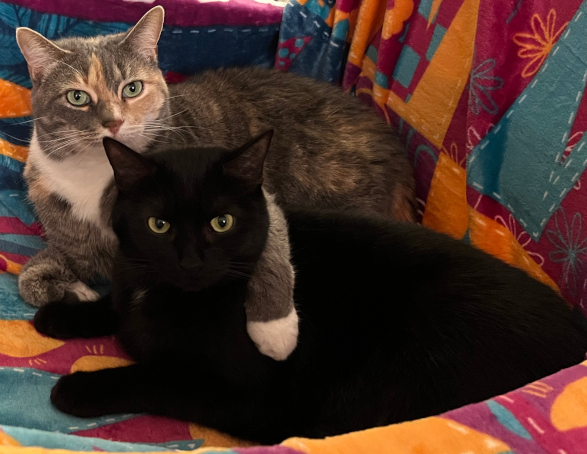
Because of all the problems with the human traits that I've talked about in these pages, I prefer to use cat coat traits to illustrate basic genetic concepts. Unlike humans, cats have several visible traits that are easy to see, really do fall into discrete phenotypes, and really do have simple genetics (one gene, two or three alleles, complete dominance). And unlike humans, cats won't be upset if a genetic trait shows that "Dad" isn't their biological father.
As an in-class exercise in collecting data, instead of asking your students whether they can roll their tongues, you can ask each student about the cat they know best. My experience has been that even students who don't own a cat have a friend or neighbor's cat that they know the hair length and color of. For larger sample sizes, students can look for pictures of cats on the internet (there are a few). I've had students use PetFinder.com, which posts pictures from pet adoption centers in hundreds of cities in the US, Canada, and Mexico, to collect data on dozens of cats as a homework assignment on cat coat genetics. It's easy to find shelters in other countries that post cat pictures online, too.
I'm not the first person to use cats to illustrate genetics, of course. Colin (1945) said that every genetics classroom should have a collection of cat skins (please don't take that advice, pictures are sufficient). Mills (1998) and Christensen (2000) describe homework assignments on cats, although keep in mind that they were written when white and white spotting were thought to be controlled by two different genes.
Looking at cats is an easy way to collect genetic data that doesn't require funding, or even a laboratory, so there are lots of old papers by impecunious geneticists with titles like "Gene frequencies in the cats of [insert city name here]." I've looked at some of these papers, and to be honest, they don't find anything very interesting. Allele frequencies vary, over small and large geographic scales, and people have speculated about the roles of migration, random drift, and selection, but it's hard to point to any clear results from the thousands of hours that people spent looking at cats.
It might be a fun class project to compare current allele frequencies in your city to those from decades ago. To find out if cats in your city have been surveyed in the past, I'd start your literature search with Shostell et al. (2005) for the United States, Canada, and Europe; Ruiz-Garcia and Alvarez (2008) for Latin America; Nozawa and Kawamoto (2013) and Nozawa (2019) for Japan; Chu (1986) for east Asia; and Jones and Horton (1984) for Australia. If you want to dig deeper into the literature, Kholin (2018) lists 348 publications on cat genetics from around the world; the text is in Russian, but the reference list is in the original languages.
If you decide to compare your data to old published data, pay attention to how the old data were collected, because allele frequencies may be different among pet cats, stray cats, and shelter cats from the same area. For example, Twedt (1983) found that 28% of the pet cats but only 8% of the stray cats in Bowling Green, Kentucky had long hair. Thinking about how different sources of cats could have different allele frequencies, and how you could test those hypotheses, is a good exercise for your students.
Long hair, Orange, and White are the three loci that I think are the easiest for students to identify. Dilute, Tabby, and Agouti are commonly recorded in population surveys, but they can be difficult to distinguish in photographs and have some complicated interactions. The Wikipedia article on cat coat genetics discusses numerous other traits.
Long hair

Long vs. short hair in cats is an excellent example of a Mendelian trait, controlled by one gene with two alleles, with one allele (L, for short hair) completely dominant over the other (l, for long hair). Most cats have short hair, but some have long hair, and this is obvious in person or in photos. I don't know if anyone has measured the hair length of a bunch of cats to confirm that it's really two discrete phenotypes with no intermediates, but that's generally thought to be true (for adult cats--young long-haired kittens may look short or medium-haired because their hair hasn't grown out yet). Cat breeders have long known from family studies that long vs. short hair is a simple Mendelian trait, with long hair recessive to short (Vella and Robinson 1999), although I haven't been able to find published family studies to support this assumption.
The only problem with using long hair as a classroom example is that long-haired cats are somewhat uncommon. If you ask your students to think about the one cat they know best, then ask them to raise their hand if it has long hair, there's a chance no one knows a long-haired cat, which is kind of boring. Fortunately, it's easy to get a bigger sample size using the internet. When I've had students look at 50 cats apiece on the pet adoption site Petfinder.com, almost all of them have seen at least one long-haired cat, so they could then estimate the allele frequencies using Hardy-Weinberg. And gathering the results from the whole class, they could test the obvious adaptive hypothesis, that the allele for long hair is more common in colder areas due to selection.
Kehler et al. (2007) did a genome-wide association study, using 513 microsatellite markers on 261 cats. They found that a single gene controls cat hair length, fibroblast growth factor 5 (FGF5), with the allele for short hair (L) being dominant to the alleles for long hair (l). There are actually four alleles (M1, M2, M3, and M4 for long hair, all of which would destroy the function of the FGF5 protein. One allele was the result of frameshift mutation, an insertion of a single base near the 3' end of the first exon, which would be likely to completely destroy the function of FGF5. A second allele has a premature stop codon in the second exon, and a third allele has a frameshift near the beginning of the third exon; these would also destroy the function of FGF5. By far the most common long-hair allele was a change from A to C in exon 3, changing a threonine to a proline in the FGF5 protein. I haven't found any publications that have figured out how this change of one amino acid destroys the function of FGF5, but apparently it does. All four long-hair alleles are recessive to the short hair allele, and they don't complement each other (meaning they don't produce short hair when two different long-hair alleles occur together). So for classroom purposes, you can lump the four long-hair alleles together as a single allele (l). /p>
Hair growth in mammals goes through cycles; a hair follicle produces hair for a set length of time (anagen), then stops for a while (catagen). When growth stops, the hair becomes weak at its base and will fall out (Hardy 1993). Hair follicles in the same area of the body have the same length of anagen, which is why most of the hairs in that area are the same maximum length. FGF5 regulates the hair follicle cycle, and when an individual has a non-functioning FGF5, anagen lasts longer and the hairs just keep growing.
Recessive, non-functional alleles in FGF5 also cause long hair in mice (Hébert et al. 1994), dogs (Housley and Venta 2006, Dierks et al. 2013), donkeys (Legrand et a. 2014), hamsters (Yoshizawa et a. 2015), guinea pigs (Yu et al. 2019), rabbits (Fatima et al. 2023), and human eyelashes (Higgins et a. 2014). The gene is also involved in cancer in humans (Katoh and Katoh 2005). For that reason, there have been a lot of molecular and developmental studies on FGF5, so you can go into as much depth as you'd like if you're teaching an advanced class.
Orange

The Orange locus in cats is an excellent example of a sex-linked gene. It also has the advantage that heterozygotes look different from either homozygote (the alleles are codominant), so you can count the genotypes and use the numbers to test the Hardy-Weinberg relationship. The Orange locus determines whether cat fur contains only phaeomelanin (the red pigment that causes red hair in humans) or a mix of eumelanin (the dark pigment found in black hair) and phaeomelanin.
The gene is located on the X chromosome, so males only have one allele. Males with the O allele on their X chromosome have the OY genotype (Y is for the Y chromosome) and are orange or cream, while males with the oY genotype are black, gray, or brown. (The variation between orange and cream, and among black, gray, and brown, is caused by other genes.) This means you can actually count the allele frequencies in males, rather than estimating them using Hardy-Weinberg the way you do for a recessive trait.
Females with the OO genotype are orange or cream, and females with the oo genotype are black, gray, or brown. Heterozygous (Oo) females aren't all black or all orange; neither allele is dominant. Instead, they have orange and black patches (or cream and gray patches, orange and brown patches, etc.), the familiar "calico" cats. (Some people limit "calico" to cats with orange, black, and white patches, and call orange and black cats without white patches "tortoiseshell." Others lump them all together as "calico," which is what I'll do here.) This means that you can count the numbers of each of the three genotypes in females, and test whether the numbers fit the expected Hardy-Weinberg proportions.
There are some interesting wrinkles to the orange locus. The reason that female heterozygotes have patches of black and orange is that early in the development of a female embryo, one X chromosome in each cell is inactivated, and it's random which X chromosome it is. So the early embryo of a cat with the Oo genotype has one cell where the chromosome with the O allele gets inactivated, and the descendants of that cell make black fur; another cell has the chromosome with the o allele inactivated, and the cells that descend from it make orange fur. When you see a patch of orange or black on a calico cat, you may be looking at a patch of skin cells that all descended from a single cell in the early embryo.
The KIT gene affects the phenotype of Oo heterozygotes. Oo females with the white spotting allele wS(calico cats with white patches, such as white paws) have big blocky black and orange patches. Oo females homozygous for the without white allele w (and therefore with no white fur) have the orange and black patches swirled around in streaks (the "tortoiseshell" pattern). I won't pretend to explain how this happens, because developmental biology makes my head hurt, but it's pretty cool and might be a good example to use in a developmental biology class.
It's not completely true that every calico cat is female, there are a very small number of male calico cats. Some are XXY, so they're male (because they have a Y chromosome) but can be calico (because they have two X chromosomes). And some male calicos are chimeras: two eggs get fertilized and form male embryos (one would be black and the other orange), start to develop, then smush together to form one embryo (something that happens in humans too).
Schmidt-Kunzel et al. (2009) mapped the Orange locus to a small region of the X chromosome, but the gene wasn't identified until 2025, by Kaelin et al. (2025) and Toh et al. (2025). The O allele is caused by a 5100-base deletion in the first intron of the rho GTPase activating protein 36 gene (Arhgap36). Because the deletion is in an intron, it doesn't affect the Arhgap36 protein sequence, but it increases transcription of Arhgap36 in hair follicle melanocytes. This affects expression of hundreds of genes in the melanocytes, including those that are involved in the production of eumelanin and phaeomelanin.
White and white spotting
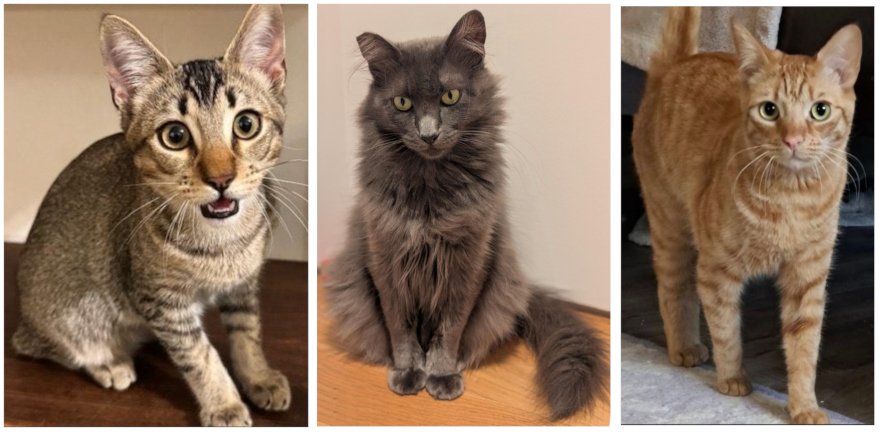
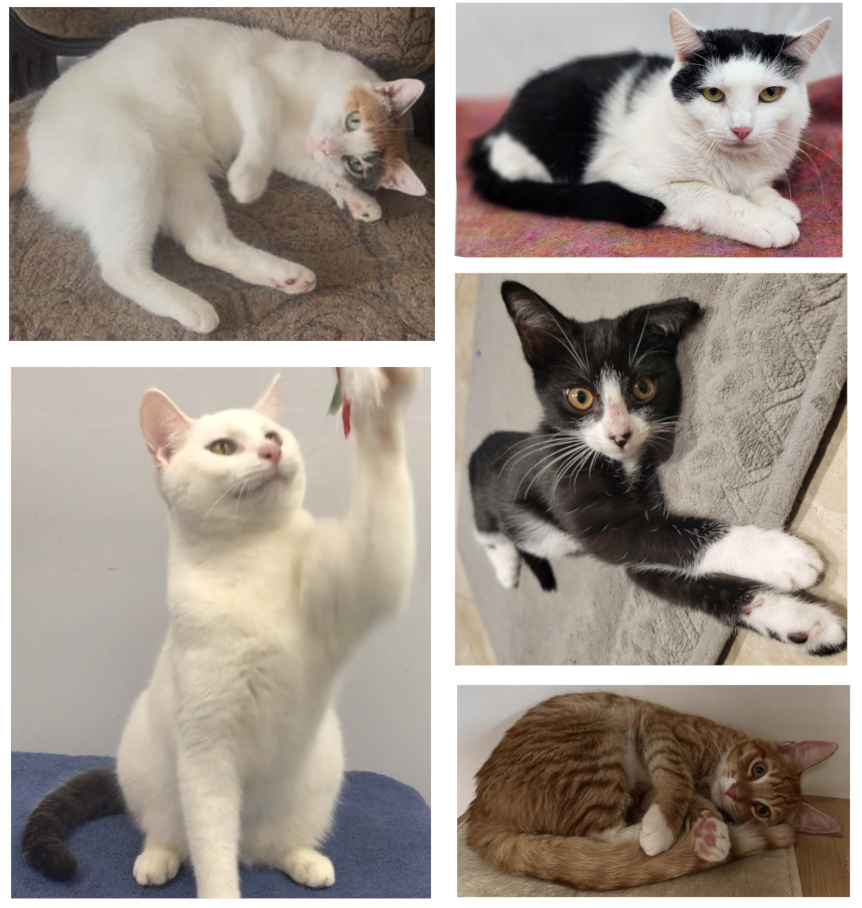
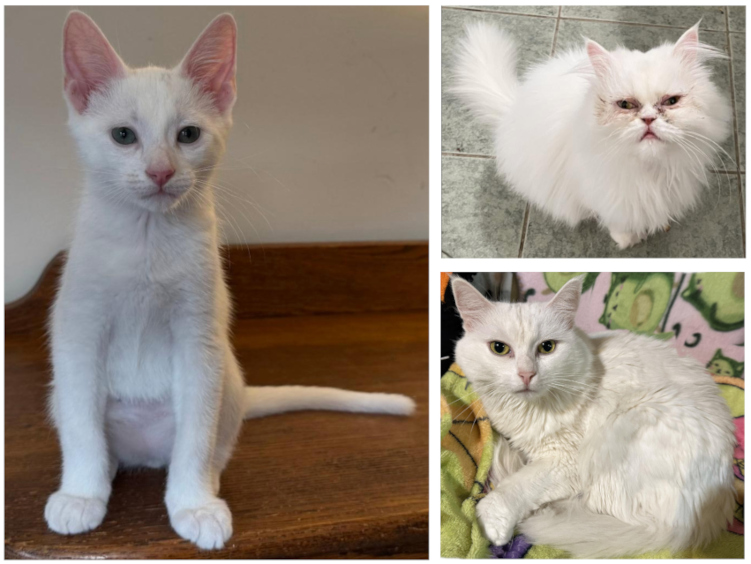
Some cats are all white, some have white patches (ranging from a few white toes to being mostly white), and some cats have no white fur at all. For a long time, it was not clear whether white fur was determined by two different genes, with all-white cats being caused by a dominant allele at the White locus (Whiting 1918), while the presence of some white areas was caused by a dominant allele at the Piebald Spotting locus, or whether the three phenotypes are determined by multiple alleles at a single gene (Whiting 1919). It took molecular studies to show that the variation is caused by one gene (KIT), coding for a receptor tyrosine kinase protein, with three alleles (Cooper et al. 2005, David et al. 2014). The W allele causes all-white fur, and is dominant to the other two alleles. The wS allele causes white spotting, or patches of white fur. The w allele causes cats without any white fur. wS is recessive to W and dominant to w, so WW, WwS, and Ww cats are all white, wSwS, and wSw, have some white, and ww cats don't have any white fur. Students often get the idea that "dominant" means more common, so the W allele is a good illustration that dominant alleles can be rare. The wS allele is a good illustration that dominant and recessive are relative concepts, as it is either dominant or recessive, depending on whether it's compared to w or W.
"White" cats are not the same as "albino" cats. Albinism is a caused by a recessive allele at the tyrosine kinase gene. White cats have white fur, but have normal colored eyes (blue, green, yellow) and areas of dark skin (nose, ears, paw pads, etc.). Albino cats have pink or very pale blue eyes, and pink skin. Albino cats are very rare.
Montague et al. (2014) identified a fourth allele, wg, at KIT that causes white paws. It is recessive to w, so only wgwg individuals display the white paws. The wg allele is common in the Birman breed of cats, but has an allele frequency of about 10% in other cats, so very few non-Birman cats have white spotting due to the wgwg genotype instead of the wS allele. You could probably ignore the wg allele for most classroom purposes, but keep it in mind if you're looking at cat pedigrees, as it could explain how two cats without white fur could have offspring with white paws.
A high proportion of white cats are deaf (Bergsma and Brown 1971, Geigy et al. 2006, David et al. 2014), which would put them at a disadvantage in nature (or on a busy street). Students often get the idea that "dominant" means "more fit," and the W allele is good illustration that this isn't necessarily true.
David et al. (2014) identified a 7125-bp insertion in intron 1 of the KIT gene as the cause of the wS allele. The insertion is a full-length feline endogenous retrovirus, so this would be a good illustration of the importance of retroviruses in generating variation. The W was caused by a 623-bp insertion of a portion of the same retrovirus, presumably due to a recombination event between a piebald spotting allele and a non-spotting allele .
Older references say that wSw cats have white on less than 50% of their body, while wSwS cats have white on more than 50%. As near as I can tell, this was based on the casual observations of cat breeders, not actual measurements. Pedigree studies (Gorska et al. 2022) do not fit this hypothesis, and neither do measurements of the amount of white on cats with different molecular genotypes (David et al. 2014, Anderson et al. 2022). wSwS cats tend to have more white than wSw, but there is considerable overlap, so it's not possible to distinguish wSwS from wSw cats by looking at them.
References
Anderson, H., et al. (13 co-authors). 2022. Genetic epidemiology of blood type, disease and trait variants, and genome-wide genetic diversity in over 11,000 domestic cats. PLoS Genetics 18: e1009804.
Bergsma, D. R., and K. S. Brown, 1971 White fur, blue eyes, and deafness in the domestic cat. Journal of Heredity 62: 171–185.
Christensen, A. C. 2000. Cats as an aid to teaching genetics. Genetics 155: 999-1004.
Chu, K. 1986. Mutant allele frequencies in domestic cats of Taiwan. Journal of Heredity 77: 277-278.
Colin, E.C. Materials used in teaching genetics. American Biology Teacher 7: 134-135.
Cooper, M. P., N. Fretwell, S.J. Bailey, and L.A. Lyons, 2006 White spotting in the domestic cat (Felis catus) maps near KIT on feline chromosome B1. Anim. Genet. 37: 163–165.
David, V.A., et al. (13 co-authors). 2014. Endogenous retrovirus insertion in the KIT oncogene determines White and White spotting in domestic cats. Genes Genomes Genetics 4: 1881-1891.
Dierks, C., S. Mömke, U. Philipp, and O. Distl. 2013. Allelic heterogeneity of FGF5 mutations causes the long-hair phenotype in dogs. Animal Genetics 44: 425-431.
Fatima, N., L. Jia, B. Liu, L. Li, L. Bai, W. Wang, S. Zhao, R. Wang, and E. Liu. 2023. A homozygous missense mutation in the fibroblast growth factor 5 gene is associated with the long‑hair trait in Angora rabbits. BMC Genomics 24: 298.
Geigy, C. A., S. Heid, F. Steffen, K. Danielson, A. Jaggy et al., 2006 Does a pleiotropic gene explain deafness and blue irises in white cats? Veterinary Journal 173: 548–553.
Górska, A., W. Drobik-Czwarno, A. Górska, and J. Bryś. 2022. Genetic determination of the amount of white spotting: a case study in Siberian cats. Genes 13: 1006.
Hardy, M.H. 1993. The secret life of the hair follicle. Trends in Genetics 8: 55-61.
Hébert, J.M., T. Rosenquist, J. Götz, and G.R. Martin. 1994. FGF5 as a regulator of the hair growth cycle: evidence from targeted and spontaneous mutations. Cell 78: 1017–1025.
Higgins, C.A., L. Petuhova, S. Harel Y.Y. Ho E. Drill, L. Shapiro, M. Wajid, and A.M. Christiano. 2014. FGF5 is a crucial regulator of hair length in humans. Proceedings of the National Academy of Sciences USA 111: 10648-10653.
Housley, D.J.E., and P.J. Venta. 2006. The long and the short of it: evidence that FGF5 is a major determinant of canine ‘hair’-itability. Animal Genetics 37: 309–315.
Jones, E., and B.J. Horton. 1984. Gene frequencies and body weights of feral cats, Felis catus (L), from five Australian localities and from Macquarie Island. Australian Journal of Zoology 32: 231-237.
Katoh, Y., and M. Katoh. 2005. Comparative genomics on FGF16 orthologs. International Journal of Molecular Medicine 16:959–963.
Kehler, J.S., V.A. David, A.A. Schäffer, K. Bajema, E. Eizirik, D.K. Ryugo, S.S. Hannah, S.J. O'Brien, and M. Menotti-Raymond. 2007. Four independent mutations in the feline fibroblast growth factor 5 gene determine the long-haired phenotype in domestic cats. Journal of Heredity 98: 555-566.
Kholin S.K. 2018. Bibliography on the population genetics of the domestic cat (Felis catus L.). Vladivostok: Federal Scientific Center of the East Asia Terrestrial Biodiversity Publ., 2018. [in Russian]
Legrand, R., L. Tiret, and M. Abitbol. 2014. Two recessive mutations in FGF5 are associated with the long-hair phenotype in donkeys. Genetics Selection and Evolution 46: 65.
Mills, V. M. 1998. Population genetics of coat characteristics in domestic cats. Pages 338-339, in Tested studies for laboratory teaching, Volume 19 (S. J. Karcher, Editor). Proceedings of the 19th Workshop/Conference of the Association for Biology Laboratory Education (ABLE), 365 pages.
Montague, M.J., et al. (25 co-authors). 2014. Comparative analysis of the domestic cat genome reveals genetic signatures underlying feline biology and domestication. Proceedings of the National Academy of Sciences USA 111: 17230–17235.
Nozawa, K. 2019. Genetic polymorphisms in coat coor and other morphological traits of the Japanese feral cats: the 5th compilation of small-island data. Report of the Society for Researches on Native Livestock 29: 105-120. [in Japanese]. [I haven't seen this.]
Nozawa, K., and Y. Kawamoto. 2013. Genetic polymorphisms in coat color and other morphological traits of the Japanese feral cats: the 4th compilation of mainland data. Report of the Society for Researches on Native Livestock 26: 107-142 [in Japanese]. [I haven't seen this.]
Ruiz-García, M., and D. Alvarez. 2008. A biogeographical population genetics perspective of the colonization of cats in Latin America and temporal genetic changes in Brazilian cat populations. Genetics and Molecular Biology 31: 772-782.
Shostell, J.M., J. Staudinger, and M. Ruiz-Garcia. 2005. Mutant allele frequencies in domestic cat populations in Arkansas and Tennessee. Journal of Heredity 96: 557-565.
Twedt, D.J. 1983. Influence of survey methods and sample sizes on estimated gene frequencies in a domestic cat population. Journal of Heredity 74: 121-123.
Vella, C.M., and R. Robinson. 1999. Robinson’s genetics for cat breeders and veterinarians. Boston: Butterworth-Heinemann.
Whiting, P.W. 1918. Inheritance of coat-color in cats. Journal of Experimental Zoology 25: 539-569.
Whiting, P.W. 1919. Inheritance of white-spotting and other color characters in cats. American Naturalist 8: 473-482.
Yoshizawa, Y., K. Wada, G. Shiomi, Y. Kameyama, Y. Wakabayashi, K. Fukuta, and R. Hashizume. 2015. A 1-bp deletion in Fgf5 causes male-dominant long hair in the Syrian hamster. Mammalian Genome 26: 630.
Yu, F., Z. Liu, S. Jiao, X. Zhang, C. Bai, J. Zhang and S. Yan. 2018. A nonsense mutation in the FGF5 gene is associated with the long-haired phenotype in domestic guinea pigs (Cavia porcellus). Animal Genetics 49: 269.
Go to John McDonald's home page
This page was last revised October 26, 2026. ©2026 by John H. McDonald. Content is available under the Creative Commons Attribution-Noncommercial license.