
⇐ Tongue rolling |
Cats ⇒
Table of Contents
Genetics of widow's peak
Summary
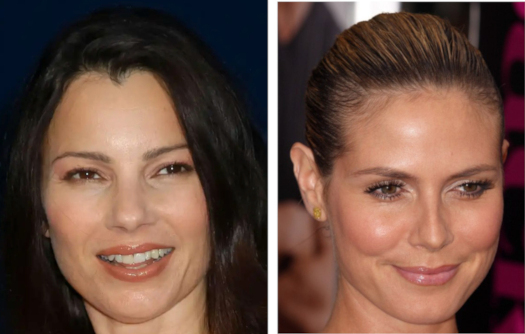
You may have heard that "widow's peak" (where your hairline points down in the middle of your forehead) is a dominant genetic trait. There is no evidence that this is true! I don't know how the myth got started; I have searched the literature thoroughly, and I have not found any scientific papers that look at the genetics of widow's peak. Maybe someone will find evidence someday that widow's peak is a simple genetic trait, but for now, don't worry if your family has two non-widow's-peak parents and a child with a widow's peak, and if you're a teacher, don't use widow's peak as an example of a simple genetic trait.
Is widow's peak a yes-or-no trait?
Look in the mirror, and pull your hair back. You might have a "widow's peak," a V-shaped bit of hairline pointind down in the middle of your forehead. Or your hairline might go straight across, without a widow's peak. Some biology teachers have used this as an example of a genetic trait.
There hasn't been a lot of research done on widow's peaks. I found only four papers that have looked at it in the general population. Smith and Cohen (1973) looked at photographs of male medical students and concluded that 32 out of 1039 (3%) had a "slight but noticeable" widow's peak and one had a "more distinctive and obvious" widow's peak. Nusbaum and Fuentefria (2009) looked at 360 women in hair salons and concluded that 81% of them had a widow's peak. Ceballos et al. (2013) said that 94% of Spanish women had widow's peaks, while Ebeye et al. (2014) said 34% of Nigerian men and 30% of Nigerian women had widow's peaks.
Unfortunately, none of these papers defined what they counted as a widow's peak. Given the huge range of frequencies, from 3% to 94%, it's obvious that different researchers had different standards of what to call a widow's peak. I'm pretty sure that if someone actually measured widow's peaks, they'd find a smooth distribution, from straight hairlines to the tiniest of widow's peak to really obvious ones, and the line between widow's peak and no widow's peak would be arbitrary.
In addition to ambiguities about who does or does not have a widow's peak, there is the problem of age. The hairline of many men recedes over time, and it often recedes more slowly in the middle. It could therefore be difficult to distinguish between a receding hairline and a true widow's peak in adult men.
Family and twin studies
There are several papers on people with rare genetic disorders who are more likely to have a widow's peak; see the OMIM entry for a list. As near as I can tell, the only person to say that widow's peak is dominant in the general population is Winchester (1951), in his widely used textbook on genetics. I don't know where he got this idea, because I haven't been able to find any published studies on the genetics of widow's peak that isn't associated with a genetic disorder.
Further research
If people are going to survey widow's peaks, someone should come up with an objective measure of "peakedness", something involving actual measurements, and then plot the distribution to see if it is a continuous trait or if it divides people into two distinct categories. I'm confident the result will be that it's a continuous trait, but it would be good to document it.
References
Ceballos, C., C. Priego, C. Méndez, M.V. Hoffner, M.J. García-Hernández, and F.M. Camacho. 2013. Study of frontal hairline patterns in Spanish Caucasian women. Actas Dermo-Sifiliográficas 104: 311-315.
Ebeye, O.A., L.E. Chris-Ozoko, P. Ogeneovo, and A. Onoriode. 2014. A study of some morphogenetic traits among the Esan ethnic group of Nigeria. East African Medical Journal 91: 420-422.
Nusbaum, B.P., and S. Fuentefria. 2009. Naturally occurring female hairline patterns. Dermatologic Surgery 35: 907-913.
Smith, D.W., and M.M. Cohen. 1973. Widow's peak scalp-hair anomaly and its relation to ocular hypertelorism. Lancet 2: 1127-1128
Winchester, A. M. 1951. Genetics: A survey of the principles of heredity. Houghton Mifflin Company, Cambridge, Massachusetts.
Go to John McDonald's home page
This page was last revised October 26, 2026. ©2026 by John H. McDonald. Content is available under the Creative Commons Attribution-Noncommercial license.